
Quick Answer
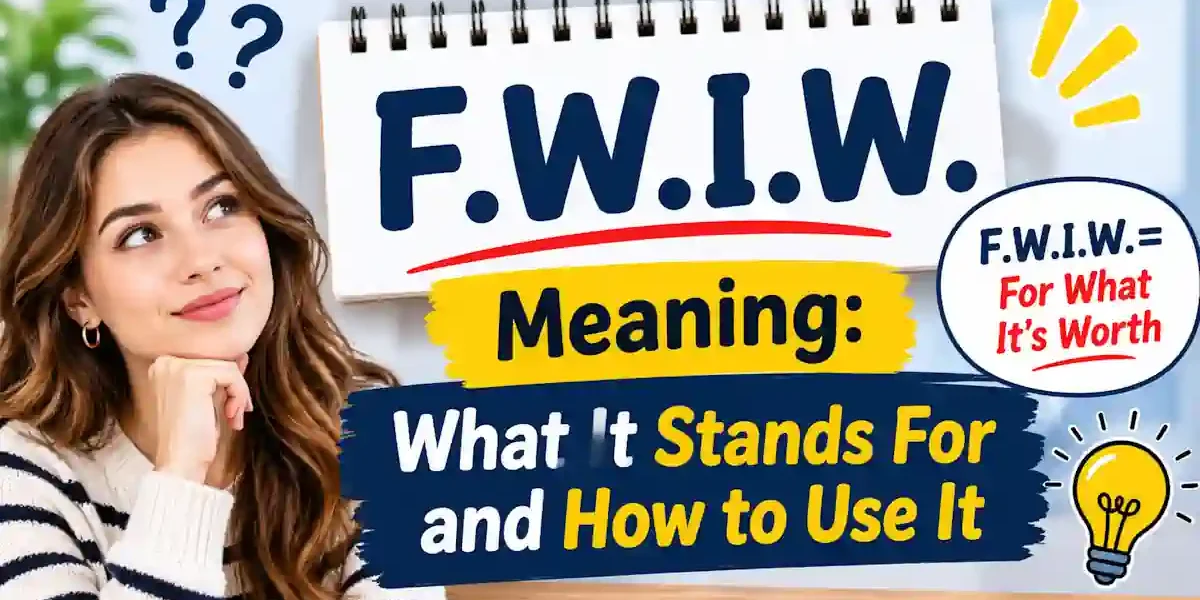
| F.W.I.W. (also written FWIW) stands for “for what it’s worth.” People use it to share an opinion, a tip, or a small fact that the other person is free to take or ignore. The periods are optional and the meaning is the same either way. |
What is the F.W.I.W.? It is for the full sentence short for “for what it’s worth.” You will often find it in texts, emails, comment sections, and work chats, just after someone is about to say something.
It might sounds modest but it could be interpreted in many different ways. This guide gives you what it stands for, its history, how to use it, and typical misconceptions on other things that the rest of the articles get wrong.
Key Takeaways
• F.W.I.W. and FWIW mean the same thing: “for what it’s worth.”
• It introduces an opinion, tip, or extra detail the reader can accept or ignore.
• The phrase “for what it’s worth” is documented in print from the 1800s, long before texting.
• The abbreviation itself shows up much later. The Oxford English Dictionary reportedly traces it to 1986.
• Tone depends on context. It is usually polite, but it can sound snarky.
• It belongs in writing. Out loud, most people say the full phrase.
• FW is not a shorter FWIW. In email, FW usually means “forward.”
F.W.I.W. Meaning and What It Stands For
F.W.I.W. – The initialism stands for, “For what it’s worth.” Every letter represents a word here: For What It’s Worth. Formatting in the letters with periods (F.W.I.W.) or without (FWIW) is a matter of style. Almost all people drop periods out of texts and online posts.
It no longer relates to money in most cases. This is usually used as a mild warning: “Here is my input, use if it helps.” It is a combination of “in my opinion” and “for your information,” with some extra caution “take it with a pinch of salt.”
What it signals to the reader
• Humility: you are not claiming to be the final word.
• Politeness: you are offering, not pushing.
• Low pressure: the other person does not have to reply or agree.
• Possible edge: with the wrong wording, it can sound dismissive or sarcastic.
Where F.W.I.W. Came From
That’s the full message here in the world of selling and buying. Over the course of history the expression meaning genuine value decided it was entirely too much into the realm of money, and, instead, became a euphemism to express an opinion.
This is followed both by an 1844 play with the same title, *Newton Foster* or the *Merchant Service*, which plays on both meanings. One character states that other person’s mind is empty of any opinion value. That shows that it was inside the realm of price talk more than 150 years ago.
A simple timeline
| Period | What happened |
| 1800s | “For what it’s worth” is an established English idiom, first tied to the value of goods and livestock. |
| 1844 | A stage play uses the phrase with a joking twist, which shows the opinion sense was already in use. |
| 1966 | Buffalo Springfield releases a song titled “For What It’s Worth,” which kept the phrase in popular culture. |
| 1986 | The earliest recorded use of the abbreviation FWIW, according to the Oxford English Dictionary as reported by Reader’s Digest. |
| 2004 onward | Search interest in FWIW rises slowly, according to Google Trends data cited by How-To Geek. |
Myths vs facts about the origin
Mainly they are repeating shaky claims in providing an origin of who coined this phrase or at least attributing it. Here’s what the documents support.
| Common claim | What is accurate |
| The phrase was first used in 1922. | Some sites credit a 1922 autobiography. That cannot be the first use, because an 1844 play already used it. |
| The Buffalo Springfield song invented the phrase. | The song made it more famous, but the idiom existed more than a century earlier. |
| FWIW began as modern text slang in the 2000s. | The 2000s are when its popularity grew. The abbreviation was recorded in 1986, so it dates to early online writing. |
| FW and FWIW are the same thing. | They are not. In email, FW usually means “forward,” and in slang it can mean something else entirely. |
| FWIW is always rude or always polite. | Neither. The tone comes from the words around it and the relationship between the two people. |
How to Use F.W.I.W. With Examples
You place it in situations where you would use “FYI” or “just so you know”. It most commonly opens a sentence, although it can work as a conclusion.
| Purpose | Example | Tone |
| Give advice | FWIW, I would wait for a second offer before quitting. | Helpful |
| Add a fact | FWIW, the meeting moved to 3 PM. | Neutral |
| Agree gently | I agree with you, FWIW. | Friendly |
| Disagree politely | FWIW, I thought the first draft read better. | Careful |
| Offer comfort | FWIW, you handled that really well today. | Warm |
| Show attitude | FWIW, I already knew that. | Snarky |
Start or end of the sentence
Both placements are acceptable. However, I personally prefer this phrase (original is: FWIW: I liked the second option)-I liked the second option, FWIW feels cuddly and relaxed.
Where it fits best
• Text messages and chats: quick asides and friendly opinions.
• Social media and forums: soften a disagreement or add context to a thread.
• Work email or Slack: suggest an idea without sounding pushy, as long as your workplace is casual.
When Not to Use F.W.I.W.
• Formal writing: reports, legal letters, and official notices need the full phrase or none at all.
• Important facts: if you have solid data, state it plainly. Hedging weakens it.
• Urgent news: do not bury a deadline or a warning behind a casual opener.
• Reminders of the obvious: telling someone something they already know can read as a put-down.
• Spoken conversation: the abbreviation is meant for writing. Out loud, say “for what it’s worth.”
Other Meanings of FWIW
A few abbreviation sites include other expansions. These are rare, so assume ” if you ask me” unless the context indicates otherwise.
| Expansion | How common | Note |
| For what it’s worth | Standard | The meaning used by dictionaries and nearly everyone online. |
| For whoever is wondering | Rare | Playful variation, mostly in casual posts. |
| For whoever is watching | Rare | Listed on some abbreviation sites. Seldom seen. |
| Forgot where I was | Rare | Mostly a joke reading, not a standard use. |
FWIW vs IMO, IMHO, FYI, BTW and TBH
| Abbreviation | Stands for | Best used for |
| FWIW | For what it’s worth | An optional opinion or tip the reader can ignore. |
| IMO | In my opinion | Stating a view directly. |
| IMHO | In my humble opinion | A view with extra modesty, sometimes ironic. |
| FYI | For your information | Passing along a fact the reader should know. |
| BTW | By the way | Adding a side thought. |
| TBH | To be honest | Sharing a frank opinion. |
Full-phrase alternatives
• “Just my two cents”
• “If it helps”
• “Take it or leave it”
• “For your information”
Conclusion
F.W.I.W. stands for ”for what it’s worth,” and probably would be one of the most effective ways of putting something out there without implying it as truth. The whole expression may be considered old-fashioned, but the abbreviation is relatively new, and the register is flexible.
You can use it when offering friendly opinions, small tips (such as gossip or advice) or mild disagreement. Be sure to keep it out of the more formal writing and be careful with your choice of words so that it is not misunderstood as sarcastic.
Frequently Asked Questions
What does F.W.I.W. stand for?
It stands for “for what it’s worth.” The version with periods and the version without them mean the same thing.
Is FWIW rude?
Not by default. Most people use it politely. It can sound snarky if the message around it is dismissive, such as “FWIW, I already knew that.”
Is FWIW formal or informal?
It is mostly informal. It can work in casual work emails, but formal documents should use the full phrase or skip it.
How do you say FWIW out loud?
Most people say the full phrase, “for what it’s worth.” The abbreviation is mainly used in writing.
When was FWIW first used?
The phrase “for what it’s worth” goes back to the 1800s. The abbreviation FWIW is traced to 1986 by the Oxford English Dictionary, as reported by Reader’s Digest.
Is FW the same as FWIW?
No. In email, FW usually means “forward.” In slang, it can carry other meanings, so check the context before assuming.
What can I say instead of FWIW?
Try “just my two cents,” “if it helps,” “in my opinion,” or “for your information,” depending on how strongly you want to state the point.